 Alumni in Action: Kosta Blank ‘17
Kosta Blank ‘17 is a data scientist for tech-giant Adobe in San Francisco. Prior to attending NC State’s MS in Analytics (MSA) program, Kosta traveled the world as a competitive tennis athlete and landed at UNC Wilmington, where he studied business and computer science. This tennis-pro-turned-software-developer channeled the discipline necessary to excel at the sport to thrive in the intensive MSA program. Today, Kosta gives us an alumnus’ perspective on navigating the job market with assistance from the Institute for Advanced Analytics’ (IAA) job placement process.
How did you become interested in analytics and why did you decide to pursue an MS in Analytics?
Blank: My path to a career in analytics hasn’t been straightforward. After completing my undergrad at UNCW I started working at Credit Suisse. In the three years at the firm I had the chance to work as a technical analyst, software developer, and data analyst. I was also very lucky to have had great mentors who pushed me outside of my comfort zone and provided me with great advice. The first time I heard about the MSA program was from one of my mentors at Credit Suisse. I had gone to an information session at the IAA, but still wasn’t sure if that was the right move for me. I started a part-time MBA program in the meanwhile because I knew that I wanted to advance my skills.
Almost a year later I moved to a team that was building data and analytics solutions within the firm. Grasping just the tip of the iceberg, I could see the potential of how powerful data science can be. That is when I realized that this is the type of work that I am passionate about pursuing. I applied to the MSA and was lucky enough to convince the interviewing committee to give me a chance. I have found that I enjoy hands-on technical work which made me a better candidate for MSA than any other graduate program.
Before the MSA program, did you have any idea of the type of industry you’d like to work in? Did that change or are you where you’d always planned to be?
Blank: After interning at a company in the healthcare industry, and spending three years in banking, I knew I wanted a change. I was always drawn to work in software development and I believed that the tech industry was where I wanted to be. I was looking for a company where I could get excited about the mission. Software development has been my passion since undergrad and I think this is a very good fit for my personality. It also aligns well with my passion to work on the newest technologies.
What were your major motivations during the MSA job placement process? How did you decide on moving across the country?
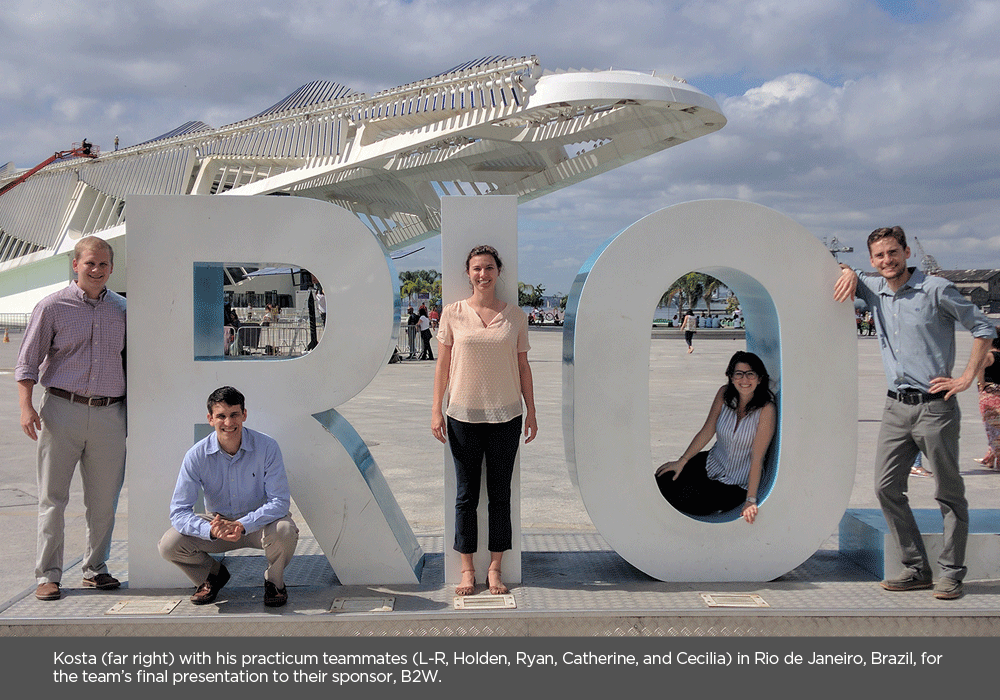
Blank: Job placement is an interesting process. It was quite hectic between all the interviews that were on campus, multiple on-site interviews that required flights and lodging, classes that had homework and team assignments, as well as the capstone project that had a strict schedule. It was interesting to learn about what employers were looking for as well as learning more about the culture and work of the teams that were hiring. My motivation was to find a company that I could get excited about and a team where I could learn from people I would work with. I was more of a “late bloomer” as far as job offer timing and it worked out to my advantage.
My biggest takeaways from the job search would be to remember that interviews are a two-way street and that learning about the hiring team is extremely important. I got very lucky to have had a choice of jobs in Raleigh, Atlanta, and San Francisco. Moving across the country wasn’t an easy decision and I am extremely thankful for my wife — she strongly supported the move to the west coast, secured an amazing job within weeks of our decision to move, and planned our itinerary for the drive through the country.
In your application to the MSA program, you mentioned your tennis career and how the sport was very much a mental game. You said that taking this approach to the sport helped you thrive in your career. How did that mindset help you during the MSA program?
Blank: The program is just as intense as everyone describes it. It requires day-to-day commitment and constant work. For me, the most important part was to keep myself focused on target and stay organized. It was easy to get overwhelmed, so it was important to keep level-headed and continue working. Playing tennis taught me to not be discouraged by failures. If it is getting a bad grade on an exam, not fully understanding a specific topic, or struggling with a project — it would make me work harder. I got to learn a lot from my fellow students and I believe we were very fortunate to have such a supportive group of faculty and staff that would always help. The most important thing is to ask for that help and communicate well.
Finally, can you tell us a bit about your work with Adobe? What is a typical day-in-life like in your role as a data scientist?
Blank: Adobe is quite a unique workplace that has a great emphasis on innovation, creativity, and work-life balance. I got lucky to work on the Sensei team — quite a large group of folks who work on many different aspects of Machine Learning to power intelligent solutions for our customers.
Specifically, my group is called Intelligent Agents and, as the name suggests, we work on agents that will reside in our applications (e.g. Photoshop, Lightroom, etc.) that will help our customers discover new features, teach them how to use named features, automate tasks, get appropriate help, and even inspire. Most of it is powered through different types of Machine Learning. My recent projects involved building a classifier to predict query intent in the search bar, building CNN models for image classification, building RNN models to predict when a customer needs help, to name a few. The technological stack is quite diverse, including Python for model building, Hive for data extraction, Spark for data cleaning, React for data visualization, as well as TensorFlow and Keras for powering the AI models. We use the Agile methodology that follows a two-week sprint schedule — every two weeks my tasks could change quite dramatically and that is what I enjoy the most.